Part1: The Sacred Center
It is still foggy when I drive into Abrantes in the morning. I have arranged to meet Marcel, a dear friend whom I have known for over 30 years. We have travelled extensively in our lives; to Israel, Egypt, Rwanda, Ethiopia, Tanzania, etc., always in the service of “the goddess”. Marcel lives in eastern Portugal, near the Spanish border, and I come from Tomar. Due to a train strike, we decide to meet halfway, at a place that is easily accessible by car for both of us: Abrantes. I remember the place as a rather large industrial city on the Tagus, the great river that flows through Portugal from east to west. However, when I use my GPS to find a parking space in the heart of the city, I get lost in the narrow alleys. Apparently, the heart of the city is much older than I thought. When I park the car and open my phone, I see the time: it is exactly 11:11.
When I meet Marcel on a small terrace, the last wisps of mist are clearing. Slowly, the sun breaks through. It’s nice to see each other again, catch up, hear each other’s stories. Marcel tells me what life is like in the countryside where he has settled, at the foot of an old mountain. He and Monique have been living there for over three months now, during which time they have taken their first steps into Portuguese life.
I report on the trip to the Amazon that is just around the corner. I’m trying to do nothing at all for a while, I tell him. Resting, looking back, not making any new adventures or plans. ‘Anne and I even bought a Netflix subscription so we can binge-watch. We just started watching the Turkish series Atiye.’
Marcel looks at me with twinkling eyes. He knows the series. It’s about a young woman, Atiye, who discovers she is a priestess of the ancient Mother Goddess. As an artist, she spends her entire life painting a symbol that leads her to Gobekli Tepe, the ancient temple near Urfa, the city of Abraham. All kinds of aspects of Turkish mystical history are discussed, as are many sacred places and special locations. The series mixes all kinds of spiritual elements, a kind of blend of The Da Vinci Code and Outlander, but it’s an enjoyable pastime. One of the symbols is the eight-pointed star, which guides the young woman on her path. “Why not a seven-pointed or five-pointed star? Eight makes no spiritual sense,” I think as I watch the series.
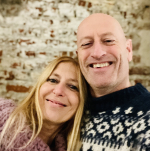
When we have finished our coffee, we decide to go exploring. Abrantes seems to have much more to offer than we thought at first glance. It turns out there is an old Templar castle in the city, and like two old Grail knights, we set off. It feels as if we were meant to meet each other in this city that morning. I take a photo of Marcel sitting against a work of art depicting a large eight-petalled flower. As we walk past the town hall, I suddenly stop dead in my tracks. ‘Hey, that’s bizarre. The city of Abrantes has an eight-pointed star as its symbol!’
Marcel laughs. “Ton, you know how it works. That’s no coincidence. We’re being guided.”
“Yes, but I thought I was taking a break, a kind of pause. I’ve just come back from the Amazon. I’m still processing the jungle and all the stories from COP30 in Brazil. And now the star seems to be leading us to another story.”
‘Isn’t the next Climate Conference in Turkey?’ asks Marcel. ‘COP31?’
‘Yes, that’s right.’ I look at him doubtfully. What does Turkey, an eight-pointed star, and Gobleki Tepe have to do with each other?
“It seems that Turkey is already calling,” he says.
I think back to two trips I once made through eastern Turkey. With a small group, we travelled to Mount Ararat. (See: “The Masters of Shambhala”) On the way, we passed through Dyarbakir, the capital of the Kurds, we were almost robbed on the Tigris, we visited the ancient city of Van, the former capital of the Armenians, we learned about the Armenian genocide and how the Armenian empire was ultimately decimated. They were intense journeys, and I remember that Turkish history had quite a few dark sides. I am not eager to return there. But let’s go, there is a star guiding us.
When we reach the highest point of the city, we arrive at the entrance to the castle. ‘Hey, that’s strange,’ I say to Marcel. ‘I know this castle, I’ve been here before. A few years ago, with Anne. I didn’t know it was here.’ The memory slowly comes back to me. It was our first few days in Portugal and we were driving through the middle of the country on the N2. It was winter and the castle was deserted. We hadn’t found our place yet and didn’t even know about the existence of the Knights Templar in Portugal.
As Marcel and I stand on top of the castle tower, we look out over the entire area: the Tagus River flowing from the mountains in the east to the ocean in the west; the area to the south, the Alentejo, and to the north, the area of the Knights Templar of Tomar. Abrantes is a crossroads of all kinds of roads, a kind of centre of Portugal. A railway line runs alongside the town, as does the GR12, a long-distance walking route.
“I remember doing a channeling here at the time,” I tell Marcel. I look it up on my phone. “Here: Abrantes, 24 February 2022. That was almost four years ago.” We sit in the sun against the castle wall and listen to the recording.
“You are on this quest that is connected to the greater story that is unfolding on earth. Be aware of that. It might seem you are travelling through fog or empty space, but every detail is important to be looked at, to be aware of. Here you are in the centre. You could call it the centre of the compass. Here you have a view in all directions, a 360-degree perspective on things. That means you cannot take sides, you cannot do this or that, up or down. You have to stay in the middle and hold all the energies together, bridging the extremes. Holding the sacred middle and connecting the vertical line between heaven and earth.
It is also true for your own journey, your own compass: that you need to stay very focused on your own middle point. Then the road will show itself naturally. Everything takes place within you. The outer world is just a reflection, a mirror of what’s happening on the world canvas.
Do you know how long this recording took? I say to Marcel. 11 minutes and eleven seconds… 11:11.
Part 2: “It is there where the eight paths meet”
After my meeting with Marcel, the eight-pointed star becomes a kind of beacon of light in the dark days around Christmas. The star appears everywhere. When Anne and I give a Christmas workshop around the winter solstice in Orval, the eight-pointed star becomes a central theme. Everyone has their own associations with it.
When I draw a tarot card, I see the image of the goddess Astarte. She stands under “the eighth gate” in ancient Babylon. The eight-pointed star is her symbol. Astarte is related to a series of other mother goddesses: the Greek Meter, or “The Mother”, the Phrygian goddess Matar, who was worshipped in ancient Thrace (central Turkey), and the goddess Cybele, who was worshipped around the Black Sea. The mother goddess is the protector of sailors and travellers, and brings new life, fertility and abundance. Cybele does not have two breasts, but her entire torso is covered with breasts.
A later goddess related to her is Aphrodite, the goddess of love from the Greek pantheon. They all seem to be names and representations of the same primordial goddess. The eight-pointed star is an image of Venus (or Sirius?) and becomes an important motif in Islamic art and religion. Everything they design – from fountains, buildings, decorations, calligraphy – is based on the number eight. Where the Jewish tradition uses the six-pointed star – the Star of David or Solomon – and Wicca often uses the five-pointed star, Islam uses the eight-pointed star. It seems to be a remnant of a distant, mystical past in which the goddess was worshipped, rather than the later father god.
I think back to Abrantes, the city in the middle of Portugal, where I found an ancient statue of the old mother goddess in the local museum, made of polished obsidian. The statue is tiny and dates from the 8th millennium (!) BC. It could well be the oldest artefact in the whole of Portugal. Most likely, it was brought over by the first peoples who sailed from the Black Sea to the Portuguese coast and founded the first European cities there: Lisbon and Porto. The black goddess was also worshipped there: she was called Cale. When the city name “Cale” was changed to Porto by the Romans, the name of Portugal was born: Porto-Cale. The word Cale still recurs in all kinds of words: Galicia, Gauls, Celts, (Celtoi), Irish Gaelic, but also in Arabic words such as Cacao, Cafe, the English Cale (cabbage), and carbon. All of them refer more or less to the colour “black”, the origin of the black goddess on the Black Sea.
The Christmas workshop ends with a large spontaneous peace ritual. The conflict between two men in the group is resolved and we decide to sit around the altar as men. We realise that men have the task of ending the wars and conflicts in the world by no longer seeing each other as enemies but as brothers. The women sit around them to support and carry the men. On the altar are eight candles surrounding a central candle in the middle. The altar also symbolises the Golden Dome, the temple in Jerusalem. It is the longest night, and we feel how important it is to bring back the light in these dark days.
PART 3: “Fire and Ashes”
When I go to see the film ‘Fire and Ash’ – part 3 of Avatar – during the Christmas holidays, I am deeply disappointed. The film seems to be a repeat of part 2, with whales, flying rocks, a battle between the N’avi and humans on boats, endless complications between the main characters and trite wisdom. It’s as if they put everything from the previous Avatars in a blender and churned out another film. It’s a shame, because I was interested in how the theme of fire would be introduced. But that was precisely what was missing. The “fire people” were rather simplistic villains and the mountain of fire only appeared briefly. Whereas “The Way of Water” contained many pearls of wisdom, the fire brought only more of the same: struggle, destruction, war.
In the real world, everything seems to be more of the same. Gaza is still the same unbearable horror, with flooded tents, civilians being shot at random, and aid convoys being consistently refused; the conflict in Ukraine drags on; Trump invades Venezuela and also wants to take Greenland; and Europe hardly dares to open its mouth because of “NATO”. It’s like a sluggish, drawn-out film that is becoming increasingly stuck in its own scenario.
‘Maybe that’s exactly what’s needed,’ says Agnes, whom I am visiting. I have been visiting her for years. She is eighty-eight and lives in a stately canal house on the Keizersgracht. “The world must first realise that this can no longer go on. And everything fits perfectly into the bigger picture.” I don’t know if I agree with her, because sometimes I can seriously resist the way things are going, but I also know that resistance achieves little. I can get very upset about it, but it doesn’t change anything. Or does it?
Somewhere I feel the message of the Avatar series: that all indigenous tribes, all people of good will, gather to form an alliance. Not against each other, or against a religion, or together against a single scapegoat, but to recognise the unity of our humanity. That we are all part of the same human family.
Together with Agnes, I tune in to the guides, as we do every year to see what is on the agenda, and the following message comes through:
“Within many places on earth, on sacred spots and holy mountains, there is an inner fire, a mystical fire, that contains all the memories of mankind, that transforms all experiences in history, and that changes destruction into creation. It releases pain and suffering, both on the individual level and the collective level. And it is these fires that need to be lit. The purpose is to light the beacons of sacred fire. Like the fire temples in Iran, Persia; the ancient temples in Syria, and Turkey, and Armenia; the sacred fires of initiation used by many shamans in South America and Africa; the mystical fires of esoteric traditions in Europe and Russia; the fire dragons in China; and many other sacred fire traditions.
Fire was given by the gods to humankind to create civilisation. But it is not only a practical fire, it is a sacred fire, and the sacred fire contains the wisdom, the divine inspiration and the divine love that kindles the heart, that kindles the mystic heart, or the sacred heart. It is this heart that is needed to bring a new vibration into the world – the vibration of the Cosmic Christ, the vibration of Cosmic Love and Cosmic Peace.
It helps you to burn the old memories of pain and suffering, to release trauma, to release old karma, karmic patterns of families, of countries, of nations and religions. And with the burning of the old, the phoenix of the new can rise. It is the energy of this phoenix that you will activate this coming year, but particularly on 9th November at Mount Ararat, to awaken the Nephilim and light the beacon of Urartu.
Unite the tribes, the family of men. Bring the heart back. Bring peace back into the world. And raise the flag of Unity. One family, one mankind, one planet, one earth, one heart.”
(5/1/2026)
PART 4: “The mystical tradition of the Sami”
When I want to fly back to Portugal after New Year’s to lead another men’s workshop, everything in the Netherlands is at a standstill because of the snow. My flight is rebooked three times and then cancelled again. The only way out seems to be a flight to Helsinki, three hours north instead of south. The next day, I have a connection to Lisbon. I call Anne.
‘Should I do that?’ I ask her. ‘Fly all the way to the far north, sleep there, and then fly across Europe to get from the north-easternmost point to the south-westernmost airport?’
‘Why not,’ she says. ‘Maybe you have something to do there, something to pick up. Invoke the powers of the North and then take them with you to the South.’
It sounds bizarre, but I trust her insight. That evening, I am on a Finnair flight to Helsinki, or Helsingor. Due to additional delays caused by snow and cold weather, I don’t arrive until 2 a.m. I take a taxi to the city, where I roll into bed, exhausted, in a hotel I chose at random. Outside, it is snowing and the temperature is dropping below zero.
When I wake up in the morning, I am in a completely different world. Large, sombre harbour buildings, an old Orthodox church (yes, octagonal) towering above the land on a rock, trams running through the dark, snowy streets, and here and there an (octagonal) poinsettia in the windows. It feels like I’ve ended up in the wrong film, were it not for the fact that the star is still guiding me on my way. I put on two jumpers, button my coat up as high as possible and walk to the church, which is surrounded by water. On the way, I see two women taking an early morning dip in a hole in the icy water. I get vicarious cramps in my lungs just looking at them. Then I realise that the temperature is probably well below zero. It is freezing cold and dark here. “Relax!” I say to myself. You are here on a mission, even though I still don’t fully understand the meaning of that.
When I arrive at the church on the rock, I feel that I am walking on holy ground. But not the holy ground of the Christian church, but of something much older. It seems that this was an ancient shamanistic place, which was later Christianised by the church.
I tune in and receive the following message:
“Many people speak about the northern light, but there is also a northern fire. It is a fire from the ground. It is what we used to heat ourselves, to bring the fire into our lives, and we cherished that fire, in the midst of cold and ice and snow. It is this fire that kept us alive.
We knew it was connected to the northern lights, to the fires in the sky, to our home, to our ancestors. We buried our ancestors in the ground, but we knew they would go back to the place we came from: Walhallah. Home of the Gods. We are still in connection with that sacred place and we kept our traditions alive, because we were so isolated and far away from the – so-called – civilised world.
The ice has a message: “Things can only work in balance. If there is ice, there is fire. You need to honour both as human beings to walk on this earth. Don’t forget where you came from, the place of origin. Honour the roots, honour the ancestors, honour the gods. They are closer than you think, they are part of you.
Activate the inner fire and connect to the northern powers, the northern energies, the northern beacons of light.”
(7/1/2026)
When the same taxi driver picks me up later to take me back to the airport, he tells me: ‘The original Finnish population was animistic. The Sami, the reindeer people, lived here. They worshipped the land, the trees, the animals, the stones and sacred places. The rock on which the church is built is probably such a sacred place. They called it “Seida”. Later, the Sami were conquered during the crusades by Catholic Sweden, which imposed the Christian religion on the people. The indigenous tradition was seemingly lost, but in the northern regions of Lapland, its soul is still preserved and revered. The wisdom of the Sami has not been forgotten, but lives on in the hearts of the people. The celebration of Santa Claus coming from the North Pole has its origins here. I look at the taxi driver’s eyes through the mirror. I wouldn’t be surprised if he himself still practises the old nature religion and is a descendant of the ancient people.
“So Santa Claus is actually an old shaman,” I think.
As we get closer to the airport, the sun rises above the clouds. It transforms everything into a beautiful, white wonderland. The darkness has disappeared. On the news, I hear that Trump wants to take Greenland, the ancestral homeland of the Inuit Indians. L’histoire se répète. Time and again, the white man, with God at his side, tries to subjugate the land and culture of indigenous peoples. Perhaps this time it’s time for the story to end differently…
PART 5: “Warriors of the Heart”
I finally arrive in Lisbon via Helsinki. I hear afterwards that many people got stuck at Schiphol Airport. Oh well, a detour via the North Pole (almost) isn’t such a bad thing. The men for the men’s group in Tomar are already on their way or have arrived.
We want to take a step forward with our Heart of Men team, with whom we have been facilitating workshops for about 10 years: what does the work require of us in the coming year?
We have invited a number of trusted participants to join us. It’s a kind of retreat, but in Portugal. There are 11 of us in the end, and once we are all together in The Gate – our workplace in Tomar – an intense and wonderful process unfolds. In one way or another, everyone is experiencing a feeling of being stuck. Old pain, old patterns, not knowing how to move forward, waiting for deliverance. “We are stuck,” says Jan. “It feels like we are in a prison and cannot find the way out.”
Outside, it is bleak, wet and cold. The only solution is to turn “inward” and explore what is holding us back. Pain and sadness are shared, but also anger and frustration. Beneath the feeling of depression and being stuck, there appears to be a lot of pent-up energy. We arrive at “sacred rage”. Usually, as men, we want to escape this uncomfortable feeling immediately, but we have learned to stay with it; not to run away, but to “sit in the fire”. When we draw a group card, we get the image of a skull, death. We descend further and further into ourselves and into the mystery. Letting go, surrendering.
We are supported by a few of our women who are tuning in at home. “Let go of all stories,” one of them texts. And indeed; we realise that we are mainly ruminating on the past. We decide to clear away the entire altar that lies in our midst and dismantle everything step by step. What remains is emptiness, space. And a tiny key with “gratitude” written on it.
On the last day, we gather at Anne’s and my house: The Gatekeepers house. We are out of prison, but there is nothing new on the horizon yet. As I look around the circle, I see eleven Templars, young and old, brothers who support each other through thick and thin. What we have to do in the coming year is still far from clear.
“It will show itself,” says Jan.
I realise that this year marks the 30th anniversary of the publication of “The Return of the King”. What I wrote then turned out to be prophetic and has lost none of its value. The world has entered a major initiation process and the role of men in this is crucial. If we as men do not make a change and cannot let go of our old role, we will continue to create the same misery worldwide. We need a new image of man: no dictators or bogeymen, no machos or conquerors, but protectors and bearers, connectors and feelers, in short: “warriors of the heart”.
Whereas in 2022 we invited 1,000 women to the ceremony on Mount Sinai, this year I feel that I want to appeal primarily to men for “Earth Heart”: can we as men use our energy to serve the earth instead of wanting to possess or use it? Can we invite young men to join with older generations in forming a new brotherhood that transcends personal gain or ego, thereby re-initiating young people into the wisdom of the sacred fire?
Can we end our inner and outer wars and conflicts and, together with women, seek a peaceful and harmonious existence on this planet before we destroy everything?
It will be an exciting year, in which the planets promise a great upheaval. On 17 April, seven planets will be in the sign of Aries, symbolising war or struggle or a new beginning and breakthrough. What will it be?
END